← Dallas–Fort Worth Epoxy Floors
Garland’s older houses have garages that stored chemicals and a second car for a long time. Oil has to come out of the surface during the grind. A coating laid over that history will stain from underneath.
Many of these stalls are detached or poorly insulated. Local pros still coat them, with a cure plan that respects afternoon heat and a flake broadcast that hides the scars the grind cannot fully erase.
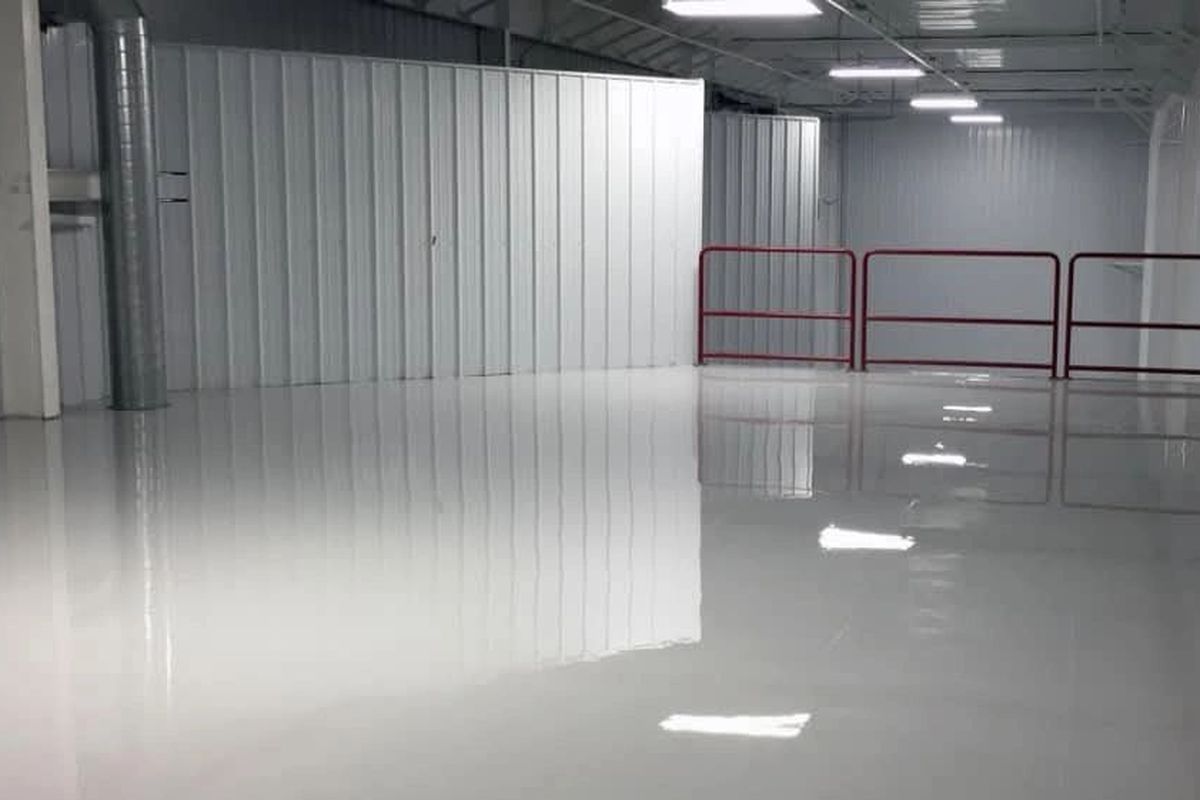
The photo is an example finish, not a documented Garland job.
A slab can look dry and still transmit moisture vapor. Before coating, ask how the contractor will assess moisture and whether the test suits the slab and coating system. Calcium chloride testing measures moisture emission at the surface; in-slab relative humidity testing measures conditions inside the concrete. Neither should be treated as a guess based on appearance or a quick hand test.
A moisture result matters because excess vapor can weaken adhesion or push a coating away from the concrete. Ask what the test found, what limit the proposed system allows, and what happens if results fall outside that limit. A clear answer should connect the test result to a specific preparation or product decision, not simply promise that the floor will be fine.
Older garage slabs may also have cracks, patched areas, or joints that move as temperatures change. Those details need inspection before grinding and coating. A contractor should explain which cracks can be repaired, which control joints should remain visible or flexible, and how any repair will look after the finish is applied. Filling every joint rigidly can lead to new cracking.
Ask whether the concrete will be diamond-ground or acid-etched. Diamond grinding removes surface material and creates a measurable texture, often described by a concrete surface profile, or CSP. Acid etching is less predictable and does not remove oil or weak concrete reliably. The quote should say how the surface will be checked before coating, not just list “prep” as one line.
A complete system has distinct layers: prepared concrete, any needed primer, a base coat, broadcast flake if selected, and a protective topcoat. Ask which layers are included and whether the flake will be fully broadcast or applied sparsely. Also ask how joints, cracks, wall edges, and the garage-door threshold will be handled. Those details affect both the finish and future maintenance.
Topcoat choice changes how the floor handles sunlight, tires, and wear. Some epoxy topcoats can amber with UV exposure; UV-stable polyaspartic or polyurea finishes may retain color better, depending on the system. Ask about hot-tire pickup resistance, slip resistance when wet, and the stated temperature and humidity limits. Confirm the cure and recoat windows, and when vehicles can return.
Yes. A past leak is not the only source of moisture vapor, and a dry-looking surface does not establish that a coating will bond. Ask for a suitable test and the result before work begins. If readings exceed the system’s limits, the contractor should explain options rather than coat over the issue.
Often it is not. Etching can create some texture, but it does not reliably remove contaminants or weak concrete. Diamond grinding lets the installer remove the surface layer and create a more controlled profile. Ask how the contractor will verify the concrete is sound and properly prepared before applying primer or coating.
No. Control joints help manage movement, so covering them rigidly can result in cracks telegraphing through the coating. The right treatment depends on the joint and system. Ask whether each joint will be left open, filled with a flexible material, or coated across, and what appearance to expect.
A smooth finish can be slick with water, dust, or oil. A coating system can include texture, such as an appropriate flake broadcast or another traction additive, but more texture can make cleaning harder. Discuss the balance for your use and ask how the finished surface performs when wet.
There is no single wait time for every system or weather condition. Temperature, humidity, slab conditions, and the specific coating affect cure. Get written instructions for foot traffic, moving items, and vehicle traffic, and follow the recoat and cure windows. Garland’s summer heat does not mean every layer cures safely sooner.
Tell us about the floor in Garland. A photo and a rough size are enough to start a written estimate. No street address on our side — local pros come to the slab.
Dallas–Fort Worth Epoxy Floors is an independent referral service that connects you with local epoxy flooring pros.
 DFW