← Dallas–Fort Worth Epoxy Floors
Mesquite sees enough hail that a garage suddenly has to hold every car, wet carpet, and roofing dirt. A coated floor makes that month less ugly. The slabs themselves are often older and already stained, so prep is not optional.
Hot-tire pickup is still the summer problem once life goes back to normal. Flake plus a real top coat is the spec local pros quote most often here.
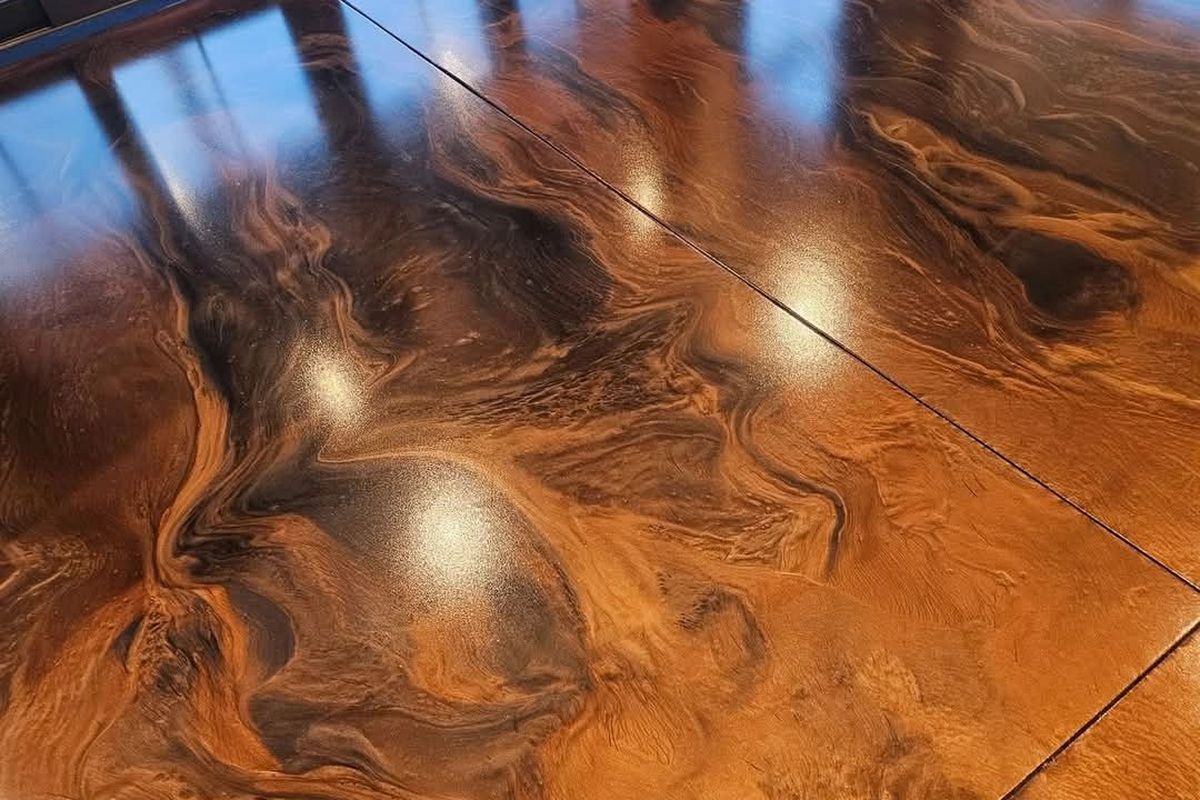
The photo is an example finish, not a documented Mesquite job.
On an older Mesquite slab, a dark patch may be oil, tire residue, an old sealer, or simply a different concrete mix. Those conditions do not all respond to the same cleaning. A contractor should inspect the floor after degreasing and identify coatings or weak surface material before pricing the system. Otherwise, a finish can bond to contamination instead of sound concrete.
Diamond grinding removes weak surface material and creates a consistent profile for the coating to grip. Ask what concrete surface profile, or CSP, the system needs and how the contractor will verify it. Acid etching is not a dependable substitute for grinding when a slab has old coatings, uneven areas, or embedded contaminants. It can leave a variable profile and residue that interferes with bonding.
A stained surface is not proof that the slab is dry enough to coat. Ask whether moisture will be checked with a calcium chloride test or in-slab relative humidity probes, and how the results compare with the coating maker’s limits. Recent rain, slab conditions, and indoor humidity can affect scheduling. If readings are too high, coating over them may lead to bubbles or debonding.
Cracks and control joints need separate decisions before the coating goes down. A stable crack may be filled and blended; a moving crack can reopen through a rigid coating. Control joints are often kept visible or treated with a flexible detail rather than filled solid. Ask which joints will be repaired, which will remain, and how the finished floor will handle movement.
A complete system usually includes a prepared slab, any specified primer, a base coat, and the selected finish. With flake, the flakes are broadcast into the wet base coat, then excess material is removed before the topcoat is applied. Ask for each layer and its purpose in writing. A primer may help with adhesion or porosity, but it cannot correct a dirty or unsound slab.
For a garage exposed to strong daylight at the opening, ask how the finish handles UV exposure. Some epoxy finishes can amber over time; UV-stable topcoat formulations can reduce that change, but products vary. Polyaspartic or polyurea topcoats may offer different cure and UV characteristics. Texture also matters: request a sample with the planned slip-resistant additive, not just a smooth color sample.
Look for areas that bead water while nearby concrete absorbs it, or for a glossy film, peeling, or uneven color. Those clues are not conclusive; oil and other contaminants can also change how water behaves. A contractor can test the surface and grind a small area to check what is present before finalizing the prep plan.
It can make a repaired crack less noticeable, but a coating does not stop concrete from moving. A contractor should distinguish stable cracks from joints designed to move, then explain the repair detail for each. If a crack is simply covered without addressing movement, it may show through the finish again.
Calcium chloride testing measures moisture emission at the surface, while in-slab relative humidity probes measure conditions within the concrete. Either result must be interpreted against the limits for the proposed coating system. Ask which method will be used, where tests will be taken, and what happens if readings exceed those limits.
The answer depends on the products, slab temperature, air temperature, humidity, and the manufacturer’s cure schedule. A floor may be ready for foot traffic before it can handle vehicle weight or hot tires. Get separate return-to-service times for walking, moving items back, and parking, in writing.
Use a soft broom or dust mop for grit, then wash with a mild cleaner suited to coated floors and a non-abrasive pad. Rinse away cleaner residue and avoid harsh solvents unless the coating maker approves them. Sand and grit tracked in on tires can wear the finish, so remove them regularly.
Tell us about the floor in Mesquite. A photo and a rough size are enough to start a written estimate. No street address on our side — local pros come to the slab.
Dallas–Fort Worth Epoxy Floors is an independent referral service that connects you with local epoxy flooring pros.
 DFW