← Dallas–Fort Worth Epoxy Floors
Home garages in Grand Prairie still want a rinseable flake floor. The shops — and there are more of them here than in a north-Collin subdivision — want a thicker, more chemical-tolerant system because oil and metal equipment are the point of the building.
Tell us what rolls across the floor. A passenger car and a welding table are not the same spec, even when they share a ZIP code.
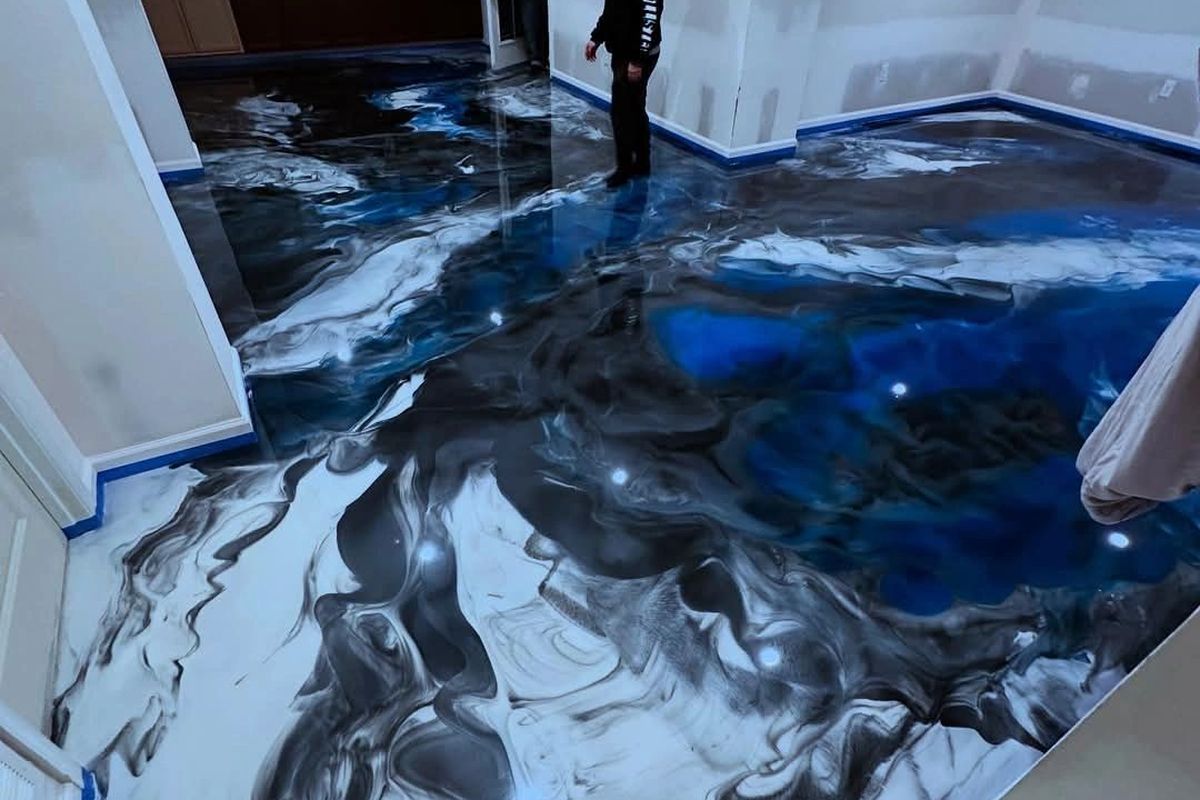
The photo is an example finish, not a documented Grand Prairie job.
In Grand Prairie, a garage or shop floor should be assessed by what it must withstand, not just by the finish sample. Oil exposure, metal equipment, vehicle traffic, and cleaning methods affect the coating plan. A site review should check the concrete for weak or peeling areas, old sealers, cracks, and contamination before anyone settles on a system or installation schedule.
Moisture deserves a separate check. Calcium chloride testing measures moisture emission at the surface; in-slab relative humidity testing measures moisture within the concrete. They are different methods, and results need to be interpreted against the coating manufacturer’s limits. A dry-looking slab is not proof that moisture vapor will not push against a new coating and cause bubbles or loss of bond.
Ask how the concrete will be prepared. Diamond grinding removes surface contaminants and opens the slab to a specified concrete surface profile, or CSP, for coating adhesion. Acid etching is not an equivalent shortcut: it may leave residue or an uneven profile and cannot reliably remove coatings or deep contamination. Cracks and control joints also need evaluation; filling them does not stop active movement.
A useful quote describes the full system, not only the visible top layer. Ask whether it includes repairs, grinding, a primer if needed, the base coat, flake broadcast where specified, and a compatible topcoat. For a shop exposed to oil or equipment, ask how the proposed layers handle those conditions and what limitations remain. Written scope makes competing bids easier to compare.
Epoxy can provide a durable base, but sunlight can make some epoxy finishes amber over time. A UV-stable polyaspartic or polyurea topcoat can improve color stability; it does not make every layer underneath UV-proof. Ask which layer supplies the working surface and how the installer balances chemical resistance, appearance, and hot-tire pickup. The right answer depends on the slab and how the room is used.
Installation timing matters in North Texas heat as well as cooler, damp conditions. Ask for the product’s temperature and humidity limits, the planned cure time before foot and vehicle traffic, and the recoat window between layers. A rushed return to service can mark or weaken a coating. For traction, discuss the texture needed when floors are wet or oily, then confirm how to clean it without harsh or abrasive methods.
Blisters, cloudy patches, or areas separating from concrete can have several causes, including moisture, contamination, or poor preparation. A contractor should inspect the failure and review test results rather than guess from appearance alone. Before recoating, remove failed material and identify the cause so the replacement system is suitable.
Cracks should be checked to see whether they are stable or moving, then repaired with a method compatible with the coating. Control joints are intentional movement points and may need to remain visible or be treated differently. Simply filling and coating every joint can lead to renewed cracking or a split finish.
CSP means concrete surface profile, a way to describe the texture created during preparation. The coating system specifies the profile it needs for a reliable bond. Ask what preparation method will achieve that profile and how the installer will verify it. A floor that looks clean may still be too smooth or contaminated.
The answer depends on the specific materials, slab conditions, and installation environment. Ask for separate written times for walking, light use, and vehicle traffic. Temperature and humidity can change curing, so a generic promise may not fit the actual job. Keep vehicles and heavy equipment off until the stated full-cure point.
Use a soft broom or vacuum for dry debris, then wash with a cleaner approved for the coating and rinse away residue. Avoid abrasive pads or unapproved solvents that can dull or damage the surface. Added texture can improve traction but may need more frequent sweeping to clear trapped grit and shop debris.
Tell us about the floor in Grand Prairie. A photo and a rough size are enough to start a written estimate. No street address on our side — local pros come to the slab.
Dallas–Fort Worth Epoxy Floors is an independent referral service that connects you with local epoxy flooring pros.
 DFW